
Highlights:
– On Semiconductor announces a major acquisition of Synaptics for nearly $7 billion, impacting stock prices.
– A continued tech sell-off affects memory and semiconductor stocks, with significant declines seen across the sector.
– Apple sees a slight rebound in stock prices despite a steep drop following significant price increases for its devices.
The Tech Sector Under Pressure: Current Landscape
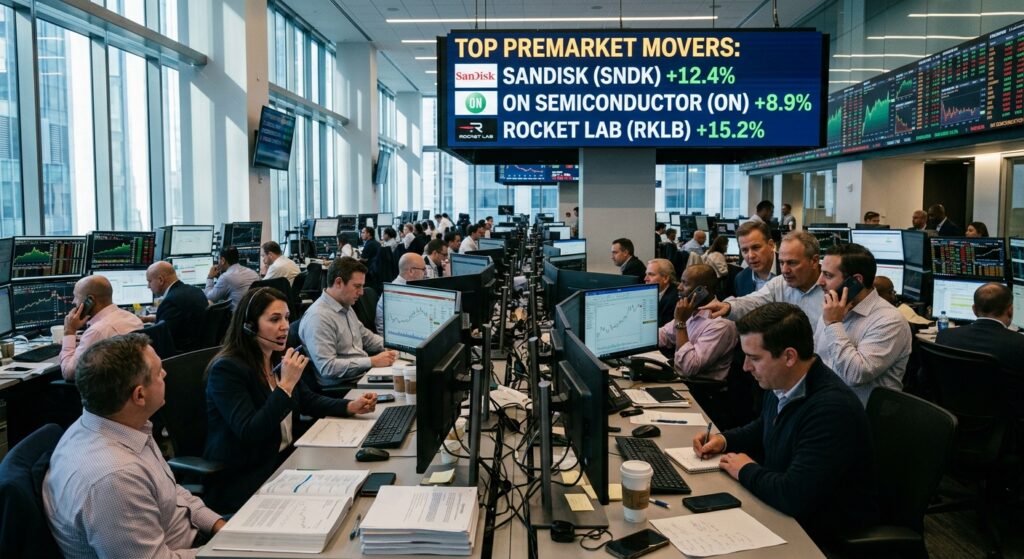
In recent trading activities, the tech industry is facing a storm of volatility as multiple companies navigate a whirlwind of stock fluctuations. On Semiconductor’s recent move to acquire Synaptics for nearly $7 billion marks one of the largest acquisitions in the company’s history. This acquisition is expected to significantly enhance On’s market reach, potentially adding an estimated $30 billion to its addressable market. However, the announcement has led to a dramatic response, with On Semiconductor’s stock plummeting by more than 15%, while Synaptics experienced a modest rise of 2.5%.
This premarket activity reflects a broader trend of declining stock prices across various technology companies, primarily driven by a tech sell-off that has cast a shadow over investor confidence. Memory stocks, including Micron and Sandisk, have faced considerable pressures, with Micron’s shares dropping over 4.5% after a brief surge post-earnings report. Such fluctuations underline the precarious state of the technology market and emphasize the need for stakeholders to closely monitor these developments.
Understanding the Dynamics of the Sell-Off
The tech sell-off has roots in several compounding factors affecting the sector. Notably, major semiconductor players have also seen negative movements, exemplified by a report from The New York Times indicating that OpenAI might postpone its IPO until 2027. This news likely contributed to investor uncertainty, resulting in declines across stocks like Arm Holdings and Marvell Technology, both down roughly 4%. Meanwhile, industry giants such as Intel and Advanced Micro Devices have also faced steep losses, with declines of 3-4%.
In contrast to this downward trend, Rocket Lab experienced a market boost of 1.5% due to NASA’s announcement that it would provide launch services for two critical research missions. Furthermore, Apple managed to bounce back slightly after a steep decline following its recent price hikes, marking a rare positive amidst the overall market downturn. This juxtaposition illustrates the varied performances within the tech sector, highlighting how certain developments can invigorate specific companies while others suffer significant consequences.
Future Implications and Potential Solutions
The ramifications of this financial turbulence within the tech sector could extend beyond immediate stock prices, affecting investment strategies and market stability as a whole. The shift in sentiment towards semiconductor and memory stocks raises essential questions for investors: How do companies adapt to fluctuations in demand and market expectations? Additionally, the consolidation trend seen through On Semiconductor’s acquisition of Synaptics may suggest a strategy for navigating these turbulent times; that is, to build stronger entities capable of weathering volatility through broader market reach.
Moving forward, solutions may lie in enhanced transparency and effective communication from tech companies regarding their future trajectories and market actions. Furthermore, opportunities for growth and adaptation in response to a changing economic landscape must be prioritized by firms looking to bolster resilience. Ultimately, companies will need to sustain innovation and strategic planning to navigate the currents of uncertainty that now dominate the tech sector.
In conclusion, the recent turbulence in tech stocks reflects broader challenges that the industry faces. As the landscape evolves with acquisitions and market sell-offs, what strategies will companies adopt to thrive? How will investor confidence shape the future of tech investments? What avenues can be explored to ensure stability amidst such volatility? These questions remain crucial for understanding the path forward for the technology industry.
Editorial content by Blake Sterling