
File photo: The Japanese national flag flies in front of the container pier in the Tokyo port.
Toshifumi Kitamura | Afp | Getty Images
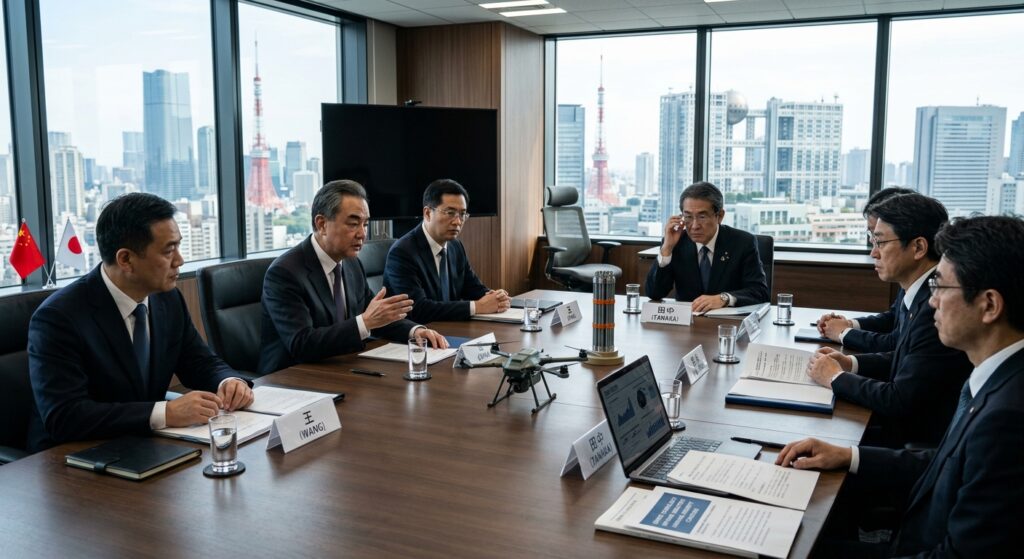
In a significant escalation of tensions, China has blacklisted four prominent Japanese defense research institutes while tightening export restrictions impacting dozens of Japanese organizations. This move represents a continuation of China’s efforts to limit Japan’s access to dual-use goods, with a particular focus on rare earth minerals critical for defense technology.
The Ministry of Commerce’s recent actions include adding 20 entities, such as the National Institute for Defense Studies and several research centers associated with ground, maritime, and aerial systems, to an export control list. Prominent corporations like Mitsubishi Electric and Mitsubishi Heavy Industries are also included. This means that no Chinese-origin dual-use items can be transferred to these institutions, and all existing activities must be halted promptly to comply with the regulations.
Pressure campaign
This latest round of restrictions is part of a broader campaign launched by China, which initially began in January when Beijing prohibited the export of dual-use items to Japan, including essential minerals like permanent magnets and rare earth elements. In February, China expanded its sanctions to include more entities tied to major Japanese defense and technology firms, reinforcing Beijing’s commitment to counter Japan’s military-oriented advancements.
The pressure on Japan has intensified following controversial statements made by Japanese Prime Minister Sanae Takaichi regarding a potential military response to a hypothetical Chinese incursion into Taiwan. This shift in tone has drawn sharp rebuke from Beijing, which argues that Japan is steering toward what they refer to as “new-style militarism.” The Chinese government insists that these stringent measures will not obstruct everyday economic or trade interactions, and thus, lawful Japanese businesses shouldn’t face undue concern.
China’s leverage
The impact of these developments on market reactions has been mixed. While companies like Mitsubishi Electric and Howa Machinery experienced declines, others, including Mitsubishi Heavy Industries and Terra Drone Corp, saw increases in their stock prices. This reaction underscores the volatility in markets closely linked to critical mineral supply chains affected by geopolitical tensions.
China’s strategy seems to leverage its control over vital mineral resources as a non-military means of influence, particularly against nations that have aligned with Taiwan. Despite Japan’s ongoing investments in domestic capabilities to process rare earths, its reliance on Chinese supply chains remains substantial. Economic experts have projected that a sustained disruption in Chinese rare earth imports could lead to a noteworthy decline in Japan’s GDP, highlighting the economic vulnerabilities intertwined with these international relations.
Highlights:
– China has escalated its campaign against Japan by blacklisting key defense research institutes and imposing tighter export restrictions.
– This has heightened tensions following Japan’s controversial defense posture regarding Taiwan and China’s growing military assertiveness.
– The economic implications for Japan could be severe, prompting reflections on dependency in critical mineral supply chains.
The Rising Tides of Tension
China’s recent decision to blacklist multiple Japanese defense research entities marks a significant increase in geopolitical tensions in East Asia. This move not only reflects the deteriorating relationship between Beijing and Tokyo but also underscores the importance of dual-use technologies that are integral to national defense. Such restrictions are perceived as part of a long-term strategy by China to assert its influence and control over critical resources while hampering Japan’s military modernization efforts.
The measures had come into effect following Japan’s firm stance toward Taiwan, indicating that Beijing is specifically responding to what it views as hostile rhetoric from Tokyo. By limiting access to rare earth minerals and other crucial technologies, China is exerting pressure on Japan to reconsider its military ambitions and geopolitical alignments. These events signify a broader struggle for power and influence within the Asia-Pacific region, spotlighting the complex dynamics of international relations.
The Implications of China’s Strategy
Delving deeper into the specifics, China’s restrictions highlight their leverage over supply chains that are essential for Japan’s technological and defense sectors. As China regains its strength in critical mineral supply chains, the ramifications for Japan become increasingly significant. Despite attempts to reduce reliance on Chinese materials, Japan remains interconnected with its supply chains—reliance which poses serious economic risks in an era of heightened competition.
Experts warn that if restrictions on imports were to be prolonged, Japan could face stark consequences. An estimated one-year halt in Chinese rare earth imports could lead to a significant drop in Japan’s GDP, magnifying fears about economic stability in the face of geopolitical strife. As Japan navigates this complex landscape, considerations of diversification in supply chains and a robust defense strategy become paramount.
Conclusion:
The escalating tensions between China and Japan signify more than just a diplomatic dispute; they reflect critical challenges concerning national security, economic stability, and international relations in the Asia-Pacific region. As Beijing strives to maintain its influence, Japan’s response will be crucial in shaping future regional dynamics. How might Japan reassess its strategic partnerships to mitigate these risks? In a rapidly evolving geopolitical landscape, what lessons can be learned to navigate the delicate balance between economic dependence and national security?
Editorial content by Avery Redwood