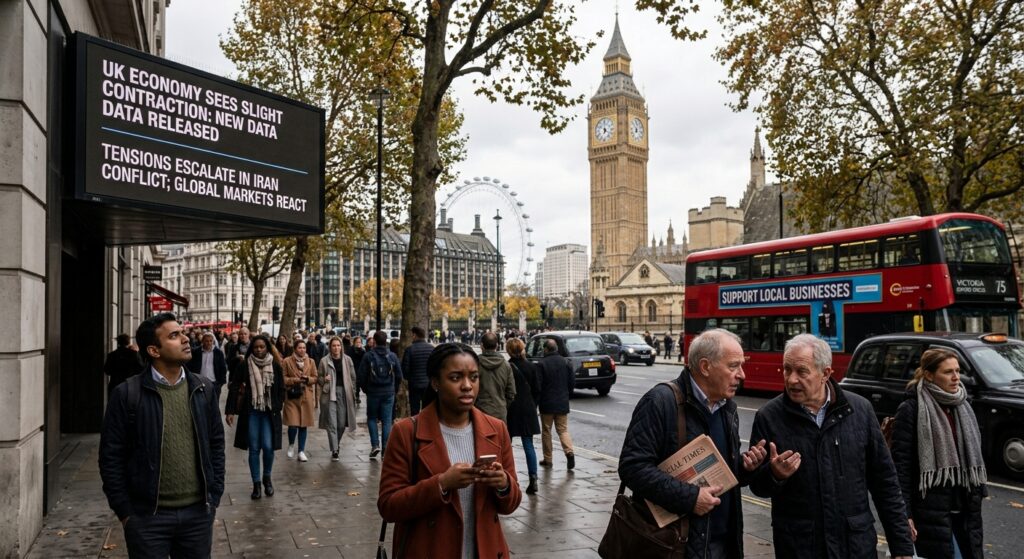
Commuters on April 20, 2026 in London, United Kingdom.
Rasid Necati Aslim | Anadolu | Getty Images
The latest economic reports indicate a concerning trend for the U.K. economy, which experienced a contraction of 0.1% in April 2026. This downturn is primarily attributed to the ongoing impacts of the Iran war, which has been a significant disruptor to global markets. As businesses grapple with rising costs and falling consumer confidence, the broader implications of this conflict are becoming increasingly apparent.
The contraction is particularly notable following a period of modest growth earlier in the year, highlighting fragility in the economic landscape. This decline particularly elevates concerns about stagnation, as the UK’s growth rate continues to be threatened by external factors such as geopolitical tensions and price fluctuations stemming from energy supply constraints.
The Direct Impact of the Conflict on Economic Sectors
A closer examination reveals that the services sector has suffered notably, with a 0.2% drop recorded, largely driven by a staggering 9.1% decline in sports, amusement, and recreational activities. The Office for National Statistics (ONS) pointed out that this marked the most substantial negative effect from a single industry on the overall services output and GDP. Events in the Middle East, including the cancellation of many sports events, contributed directly to this decline, affecting not just entertainment but also various supporting industries such as manufacturing and transportation.
Moreover, businesses across numerous sectors reported decreased revenue due to the Middle East conflict. Specifically, energy costs prompted by the war have severely strained household budgets and business expenditures, eliciting a consumer response characterized by reduced spending. The ONS highlighted concerns over rising energy prices, which have drastically reversed a previously positive growth trajectory observed in early 2026.
Long-term Projections and Economic Strategies
The implications of a contracting economy extend beyond short-term statistics; experts indicate this could lead to an ongoing cycle of stagflation if corrective measures are not effectively implemented. Suren Thiru, chief economist at the Institute of Chartered Accountants in England and Wales, suggests that a rate cut by the Bank of England is now less likely, given the economic trajectory. Concerns regarding inflation remain particularly salient, with forecasts significantly adjusting downwards as a response to the ongoing crisis.
The International Monetary Fund (IMF) also recently downgraded its expectations for U.K. economic growth for 2026 to just 0.8%. Rising costs and supply issues signal a turbulent future for the economy without substantial policy interventions. As consumers face increasing energy bills amidst rising prices, the government may need to consider strategic approaches to stabilize the economy and address growing inflationary pressures.
Highlights:
– The U.K. economy shrank by 0.1% in April 2026, influenced largely by the ongoing Iran war.
– The services sector saw a significant contraction, particularly in sports and recreational activities, affecting overall GDP.
– The International Monetary Fund has revised U.K. growth forecasts sharply downward, indicating potential for long-term economic challenges.
Introduction to Current Economic Challenges
The U.K. economy is facing a notable contraction, with data revealing a 0.1% decline in April 2026 largely due to the ramifications of the ongoing Iran war. This downturn marks a troubling shift in economic momentum, especially following a period where incremental growth seemed to set a positive tone for the year. The impact of the war has rippled across various sectors, instigating shifts in consumer behavior and business operations that have alarmed economists.
As the conflict in the Middle East continues to disrupt supply chains and heighten energy costs, it’s crucial to understand the broader significance of these developments. The April figure stands as a stark reminder of how geopolitical events can significantly influence domestic economies, prompting discussions about vulnerability and resilience in global markets.
Analyzing the Economic Upsurge and Downturn
Diving into the statistics, the most pressing issues emerged from a 0.2% contraction within the services sector, an area that typically contributes substantially to the U.K.’s GDP. The ONS reported a remarkable 9.1% drop in the sports and recreation sector, which was further exacerbated by cancellations of events in the Middle East. This segment’s dismal performance accounted for the largest negative contribution observed, illustrating the interconnected nature of global events impacting local economies.
Moreover, firms in manufacturing, transportation, and related services have expressed concern regarding their shrinking revenues as rising fuel prices and costs stifle operations. Specifically, the ONS noted that heightened energy costs, driven directly by the conflict, have altered consumer spending patterns, resulting in a decreased appetite for consumption as households tighten budgets in response to soaring expenses.
Implications for Future Economic Strategies
The ramifications of this economic contraction extend beyond immediate data points. Experts warn of a rising tide of stagflation—a difficult combination of stagnation and inflation that poses risks to job growth and consumer spending. With the Bank of England likely sidelined from implementing rate cuts in light of these developments, maintaining economic stability amid rising inflation becomes increasingly complex.
Further complicating matters, the International Monetary Fund’s downward revision of U.K. growth forecasts to just 0.8% signals substantial concern regarding long-term economic health. As energy costs show no sign of easing, and consumer prices rise further, government intervention will be crucial. Policymakers may need to deploy strategies to mitigate negative impacts on the economy while crafting pathways for recovery and sustained growth amidst a challenging global framework.
In conclusion, the recent contraction represents more than just a slow economic month; it serves as a critical juncture in understanding the broader implications of international conflicts and their potential to shape national economies. As stakeholders reflect on the current situation, questions arise: How will the U.K. adapt its economic policies in response to external shocks? What measures can be taken to mitigate the effects of global conflicts on domestic stability? And how might businesses strategize to stay resilient amid such volatility?
Editorial content by Blake Sterling